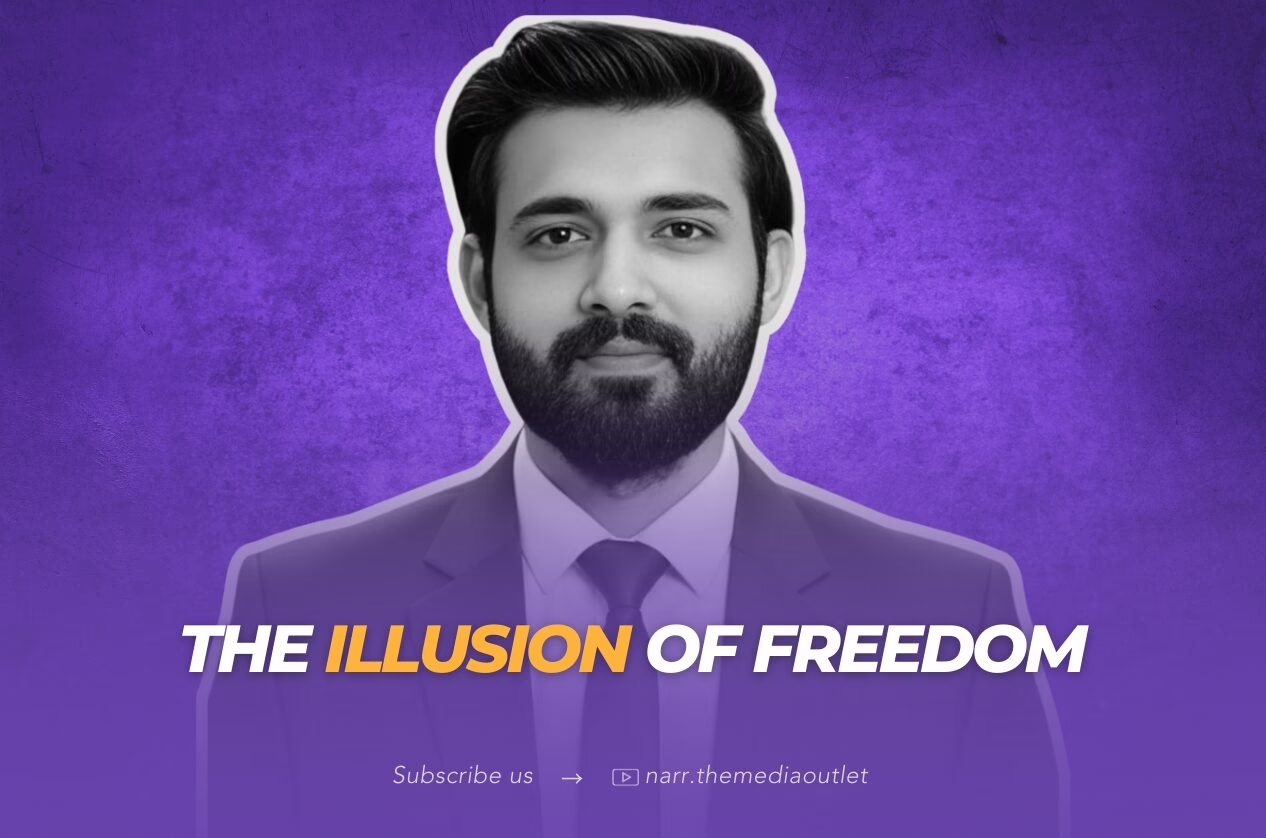
Aasim Irshad | Published December 13, 2025
“The body is free. The spirit remains captive.”
We often move through life without realising how many quiet forms of slavery shape our everyday. These chains do not make noise. They sit inside our homes, in our workplaces, and in our thoughts. They tell us what to do, how to act, and who to become. Most people accept them because they look like normal parts of life. Yet they limit our freedom in ways we rarely admit.
A young person grows up with love around them, but also with pressure that is easy to mistake for care. A parent insists on a certain career. A relative warns against choices that seem too bold. A neighbor comments on how a child should dress or behave. None of this looks harmful at first, yet it often blocks a person from becoming who they truly are.
“Pressure often disguises itself as care.”
Social expectations work in a similar way. They reward those who follow the crowd and quietly push others back into the same old patterns.
The workplace creates its own set of chains. Many employees learn early that honesty can be risky. They stay quiet to protect their jobs. They follow orders even when those orders make little sense. A culture that praises obedience over creativity slowly turns into a cage. People stop questioning. They stop growing. They stop imagining a different life.
“A culture that praises obedience over creativity slowly turns into a cage.”
Traditions also play a strong role. Many traditions offer comfort and identity. They keep communities connected. But some traditions ask for blind loyalty. They create rules that no one is allowed to question. Generations follow the same choices simply because they were told to.
Misinterpreted religious teachings add another layer of pressure. Faith is meant to guide the heart. But when people twist teachings to control others, faith becomes a tool of fear.
“Faith is meant to guide the heart, not control it.”
These are the personal chains. They touch the home, the office, and the inner voice. But the wider world adds more weight. Political conditioning shapes how we look at society. Leaders and parties offer simple stories that divide people into groups of them and us. When these stories repeat again and again, they turn into a belief.
“Politics is supposed to serve citizens, not shape their identities.”
Business interests also influence our choices. Companies spend years studying human behaviour. They know how to make people want things they never needed. A simple desire turns into a demand. A demand turns into a habit. People start measuring their happiness by what they buy.
“The market becomes a silent ruler that tells us how to live.”
Then there is the routine of modern life. The clock becomes a strict guide. Wake up at a certain time. Work for a fixed number of hours. Rest when the schedule allows. Repeat the same cycle week after week.
The pursuit of popularity has grown stronger in the digital age. People want approval. They want to be seen. They want to be liked. Social media gives the illusion that attention equals value.
“Comparison turns life into a race that never ends.”
Financial pressure is perhaps the strongest of all chains. Every choice becomes linked to income. People delay their dreams because they need security. They stay in jobs they dislike because leaving feels dangerous.
“Money becomes both a shield and a prison.”
When we look at human history, the picture becomes even more striking. Humanity has broken many visible chains. Empires fell. Monarchies dissolved. Colonies gained independence. Yet the inner chains never disappeared.
“We no longer serve masters, but we serve expectations.”
This is the contradiction of the modern world. Humanity won freedom on paper but not in practice. Many people believe they are making their own choices while they are simply following patterns laid out by others.
A neutral and balanced view shows that not all pressure is harmful. Families often care sincerely. Traditions create identity. Religion offers moral direction. But when any one force becomes too strong, it begins to control rather than support. Freedom is not a sudden moment. It is a slow and thoughtful process. It grows each time we pause and ask why we are doing something.
About the author: Aasim Irshad is a journalist specializing in socio-political analysis and historical perspectives.
More from the author
From Doctrine to Decline: How Pakistan’s Judiciary Lost Its Autonomy
Published November 20, 2025