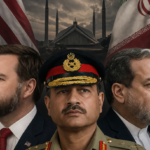
Why Iran war was inevitable is not a question of sudden escalation but of structure. Wars are rarely accidents. The US-Israeli attacks of aggression on Iran in February 2026 were the culmination of decades of deliberate choices; military buildups, broken negotiations, and strategic deceptions, each individually defensible, collectively catastrophic.
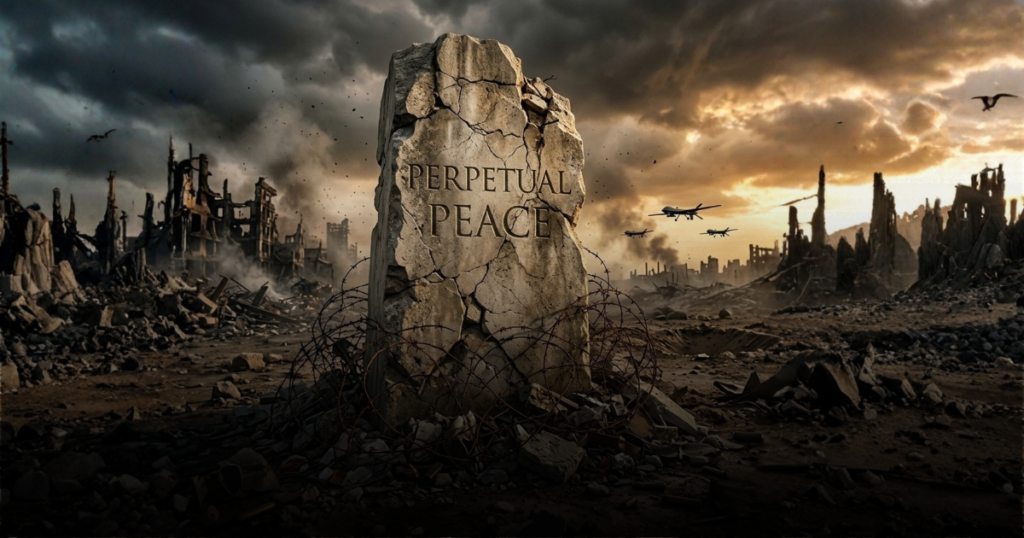
Immanuel Kant, the most consequential moral philosopher of the modern West, had theorised this pattern two centuries ago.He described the conditions that make peace structurally impossible, and outlined a framework for dismantling them, one, that has been repeatedly set aside by the very powers that hinge their moral high ground on order, rationality, and peace.
Kant’s Perpetual Peace and Why Iran War Was Inevitable
The war now unfolding around Iran has already exposed how quickly modern conflict escapes its supposed limits, pulling in trade, energy routes, and proxy actors. What appears as escalation is, in Kantian terms, the predictable result of a system that has ignored the conditions of peace. It is at this level, not tactics, but structure, that the war must be judged.
Kant’s essay Perpetual Peace: A Philosophical Sketch (1795) is no naive idealism but a plan of how to avoid precisely this type of escalating violence. And put to the stricter test, the principles of Kant do not only criticize the war, but they also accuse the system that produced it as necessary.
Diplomacy Failure and the Structural Causes of the Iran War
Kant’s first condition for peace is deceptively simple: diplomacy must be transparent. Secret reservations and strategic deception lay the groundwork for future war. The Iran conflict exposes this failure starkly.
Military strikes were launched even as nuclear negotiations were ongoing. What does negotiation mean if it can coexist with imminent bombardment? It transforms diplomacy into performance rather than commitment. This is not merely a geopolitical miscalculation; it is rather a betrayal.
Imagine being an Iranian civilian following news of “talks,” only to wake up to explosions. Kant would argue that peace died not when missiles flew, but when words lost meaning.
Militarization and War Inevitability in the US/Israel-Iran Conflict
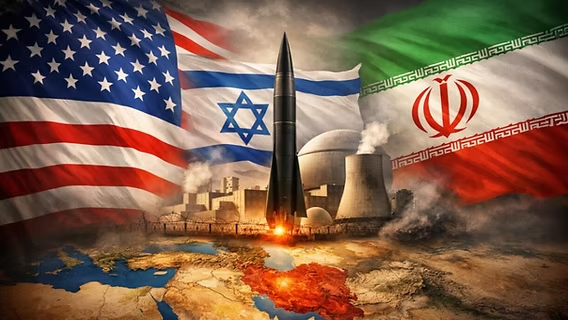
Kant warned that standing armies perpetuate war by making it always possible. In the Iran case, years of military buildup; American deployments, Israeli preparedness, Iran’s missile expansion; created a condition where war was not only possible, but structurally likely. The region had become a loaded gun. Even before the war, the Middle East was saturated with military presence. When tensions peaked, escalation required no transformation, only activation.
This reinforces why Iran war was inevitable within a system that normalizes escalation. Today, that same machinery continues to fuel retaliation across borders, from Gulf states to the Levant. For civilians, this means living under permanent anticipation. War is no longer an event; it becomes an atmosphere.
Democratic Accountability and Kant’s Theory of War
Kant argued that republics, where ordinary people carry the burden of war, should be far more cautious about starting one. The logic is simple: if you are the one who might be sent to fight, your voice should matter. But reality feels far removed from that ideal. In the United States, many people don’t want ground troops deployed. They want the violence to stop, not deepen.
And yet, the war moves forward anyway. The gap between what people want and what governments do is where Kant’s warning becomes painfully real. Decisions about war are being made at a distance from those who will live with the consequences.
International Cooperation Failure in Modern Conflict
Kant did not envision a world government, but a voluntary federation of states committed to preventing war. Today’s international system, nominally built on similar ideals, has failed to act as such a restraint. Instead of collective mediation, we see fragmented alignments and competing interests. The deeper Kantian point is that such a federation cannot be imposed from above; it must emerge from states voluntarily recognising that their long-term survival lies in renouncing war as an instrument of policy. Whether the current conflict accelerates or permanently forecloses that recognition among the states observing it is perhaps the most consequential open question the war has produced.
War Beyond Strategy: The Human and Global Cost
Perhaps Kant’s most radical idea is cosmopolitan right; the notion that individuals, not just states, are subjects of moral concern. War, then, must be judged not only by strategic outcomes but by its impact on human beings. And in this context, the Iran war is devastating.
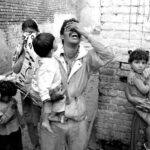
Strikes have hit not only military targets but also infrastructure such as schools, hospitals, and civilian areas. Families are displaced, economies shattered, futures erased. Beyond the region, rising energy prices and financial instability are affecting millions who have no stake in the conflict. Kant would ask a simple but piercing question: are these people being treated as ends in themselves, or merely as collateral? The uncomfortable answer is evident.
There is, however, a deeper tension in Kant that the Iran war forces to the surface; one that even sympathetic readers tend to gloss over. Kant did not merely demand that states behave better; he argued that a certain kind of state, the republic, was structurally less inclined toward war because it internalized the cost of it. The tragedy of the present conflict is that this structural logic has been inverted. The republics involved, precisely because they are republics, have become adept at managing the optics of war rather than its reality: packaging devastation in the language of defence, framing aggression as reluctant necessity, and insulating decision-makers from accountability through layers of institutional procedure. The form of republican government survives while its Kantian substance is quietly evacuated.
One is reminded here of a familiar philosophical irony: the very mechanisms designed to restrain power; deliberation, representation, legal authorisation; become, in sufficiently practised hands, instruments for legitimising what they were meant to prevent. Kant understood that peace required not merely the right institutions but the right spirit animating them. What the Iran war reveals is that institutions without that animating conscience are not safeguards. They are alibis.
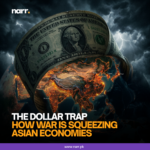
Kant anticipated that economic interdependence could either promote peace or amplify conflict. In today’s globalized world, the Iran war demonstrates both. The closure of critical routes like the Strait of Hormuz has disrupted global energy supplies, driving inflation and instability across Asia and beyond. Corporations are now direct targets and economic systems are increasingly entangled with military strategy. War is no longer confined to battlefields; it is embedded in supply chains and mortgages. The deeper lesson is why Iran war was inevitable, not exceptional.
Why Wars Are Not Accidents: A Kantian Conclusion
It is tempting to dismiss Kant as unrealistic. After all, his conditions for peace; transparency, demilitarization, democratic accountability, international cooperation; seem almost utopian in today’s geopolitical climate. But the Iran war suggests the opposite.
Kant was not idealistic enough. He underestimated how systematically these principles would be ignored and how predictably their absence would produce exactly this kind of conflict. The tragedy is not that his ideas failed, but that they were never seriously tried. Peace, in Kant’s vision, is not a natural state. It must be constructed deliberately. Understanding why Iran war was inevitable is essential to preventing future conflicts. Until then, wars like this one will not be anomalies. They will be inevitabilities.