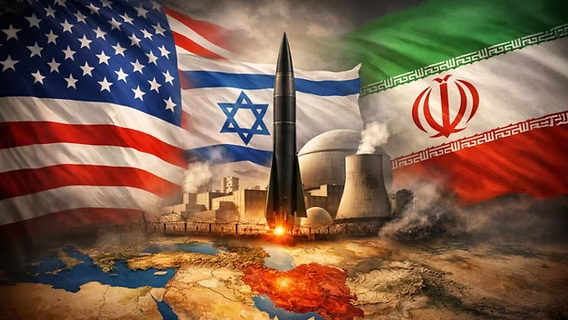
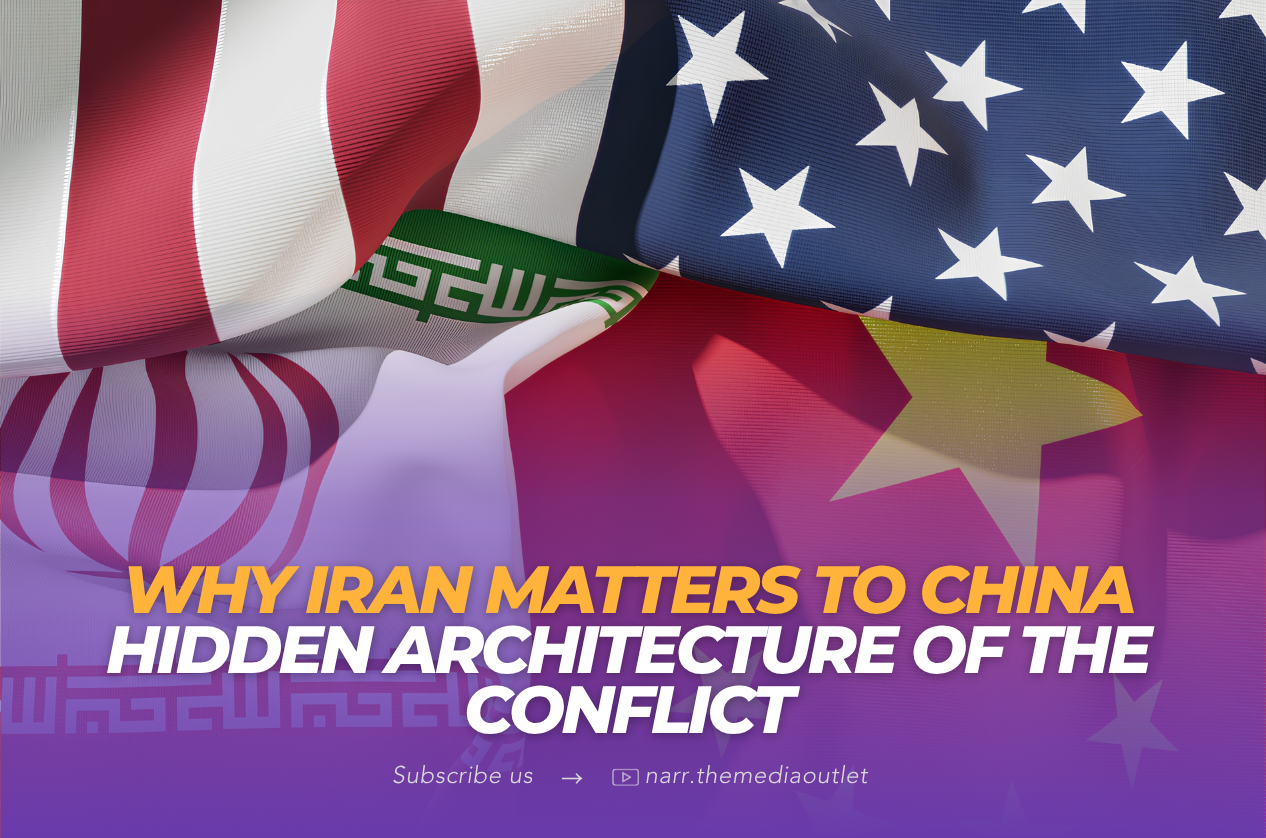
The US Iran war 2026 has generated predictable debates: was the intelligence on Iran’s nuclear restart credible, was the strike during active negotiations legally defensible, and does killing a supreme leader constitute targeted assassination or an act of war? These are legitimate questions, but they operate at the wrong level of analysis. Operation Epic Fury is not primarily a nonproliferation event. Instead, it marks the first American military campaign to directly target a structural pillar of Chinese grand strategy. Whether by deliberate design or geopolitical accident, its consequences will extend far beyond Tehran. This reflects a broader pattern in US foreign policy in the Middle East, where strategic priorities often override institutional processes.
China’s Structural Investment in Iran
Before Operation Epic Fury can be understood, Beijing’s investment in the Islamic Republic must be examined. Since 2021, nearly all Iranian petroleum exports have flowed to China through a complex sanctions-evasion network. Ageing tankers disable AIS transponders, conduct ship-to-ship transfers off the Malaysian coast, and relabel crude before delivering it to refineries in Shandong.
The Congressional Research Service confirms that these methods, including spoofed GPS signals and falsified cargo manifests, allow Iran to export roughly 1.38 million barrels per day. This generates an estimated $31 billion annually, or nearly 45% of Tehran’s budget. The 2021 Comprehensive Strategic Partnership, committing Beijing to $400 billion in Iranian energy and infrastructure, formalised what dependency had already made structural. A dependent Iran is a useful Iran.
Technology, Surveillance, and Regime Stability
The technological dimension is less visible but more revealing. A February 2026 Article 19 report found that Huawei, ZTE, Tiandy, and Hikvision supplied Iran with surveillance systems, including facial recognition and deep packet inspection tools.
When the regime imposed a near-total internet blackout during the January 2026 crackdown, it relied on infrastructure built by Chinese firms. NetBlocks recorded connectivity collapsing to 4% of baseline, while Amnesty International documented killings before the blackout was complete. The same surveillance model used in Xinjiang was effectively reproduced in Tehran. This suggests that Beijing’s interest in regime survival is not rhetorical, but operational.
Proxy Warfare and the Red Sea Dimension
Iran’s role in China’s strategy extends into proxy warfare. When Houthi forces attacked Red Sea shipping in late 2023, traffic through the Bab el-Mandeb dropped sharply. By mid-2025, the US response had consumed a significant share of advanced missile interceptors.
China, however, bore none of these costs. Instead, it amplified them. In April 2025, the US sanctioned Chang Guang Satellite Technology for providing geospatial intelligence to the Houthis. Chinese-linked vessels continued operating with relative immunity. Each interceptor used in the Gulf reduced US readiness elsewhere. In particular, it constrained resources available for a Taiwan contingency. This is not incidental to Chinese strategy, it is central to it.
Gulf Alignment and the China-Iran Strategy
China has spent two decades using Iranian regional aggression as an entry point for deepening ties with America’s most important Gulf partners. GCC imports from China tripled between 2008 and 2025. In March 2023, Beijing brokered the Saudi-Iranian normalization agreement; inserting itself into the Gulf’s security architecture in a way no military deployment could have achieved. The US-China Economic and Security Review Commission documented that Beijing’s explicit aims in the Gulf include garnering Arab state support for China’s position on Taiwan and the South China Sea. Saudi Foreign Minister Faisal bin Farhan reaffirmed Riyadh’s one-China stance as recently as December 2025. That alignment will matter most if a Taiwan crisis arrives: China imports roughly 70% of its oil through the Strait of Malacca, a chokepoint that becomes contested the moment that confrontation begins. A Gulf already embedded in Beijing’s economic orbit is a Gulf that supplies China with an energy reserve Washington cannot disrupt; and that declines to participate in the sanctions architecture the US would need most.
Operation Epic Fury and Strategic Consequences
Operation Epic Fury targeted the central node of this system. China’s response suggests it recognised the stakes immediately. Even after Operation Rising Lion reduced Iranian enrichment facilities to rubble, China moved immediately to reconstitute what had been destroyed: finalising supersonic anti-ship missile deals and shipping propellant chemicals sufficient to rebuild a substantial portion of the ballistic stockpile Israel had spent 12 days destroying. The House of Commons Library noted that Omani mediators had assessed
significant Iranian concessions during February 2026 nuclear talks; enough that, in London’s
judgment;
“Diplomacy had not been exhausted before the first strike landed.”
The Indo-Pacific Begins in Tehran
The US Iran war 2026 may mark the opening move of the Indo-Pacific century. However, whether it does so strategically remains uncertain. What is clear is that Operation Epic Fury did not simply target Iran. It disrupted an interconnected system linking energy, surveillance, proxy warfare, and great power competition. The question is no longer whether Iran matters to China. It is how far the consequences of that relationship will extend.