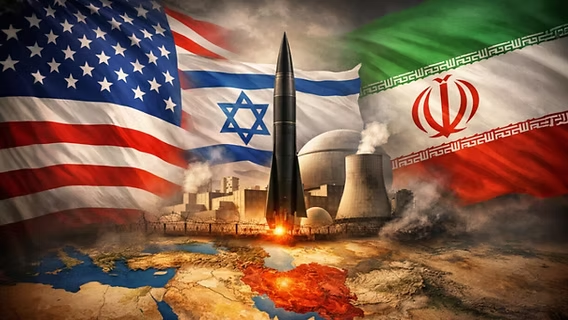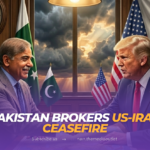
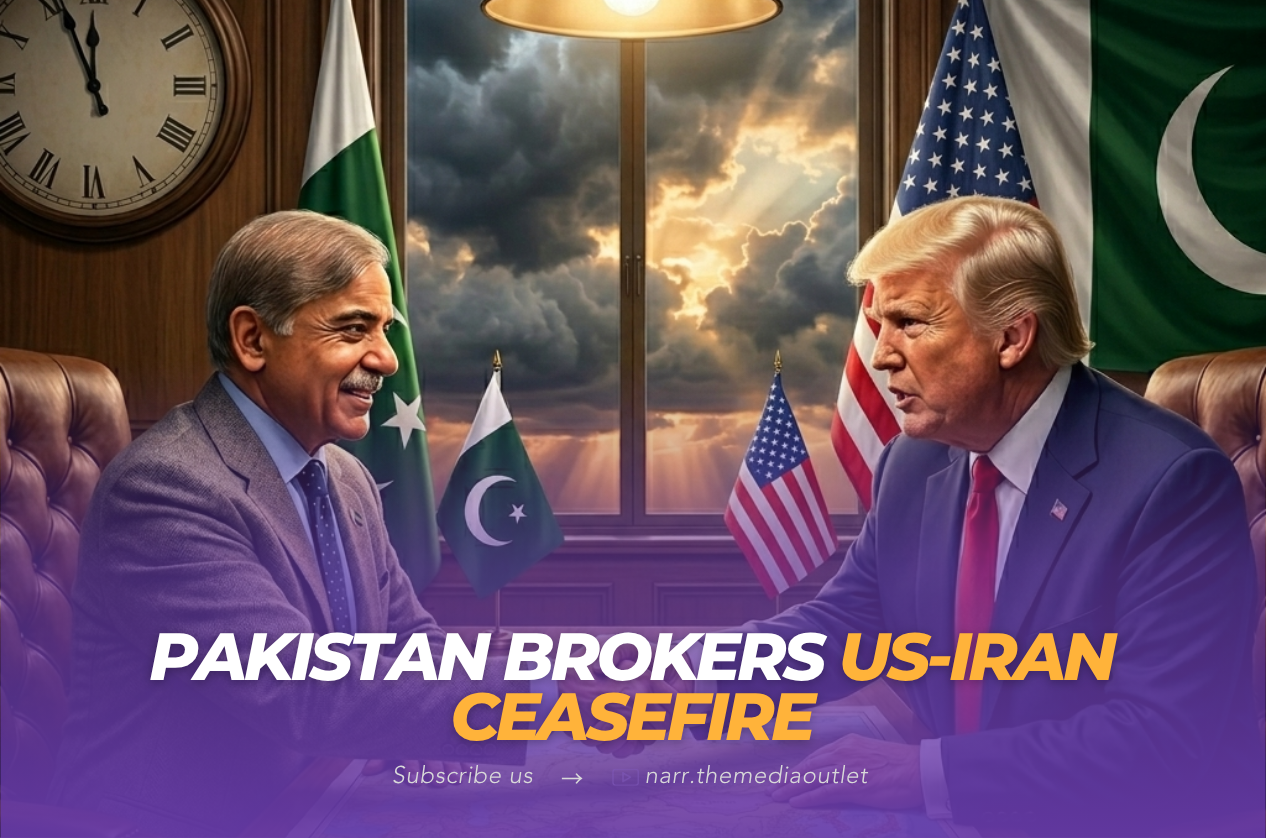
On the morning of April 8, 2026, Pakistan’s Prime Minister Shehbaz Sharif posted a message that the world had been waiting weeks to read. “I am pleased to announce that the Islamic Republic of Iran and the United States of America, along with their allies, have agreed to an immediate cease-fire,” he wrote; adding “EFFECTIVE IMMEDIATELY” in capital letters, echoing President Trump’s own typographical style. It was a small stylistic flourish that said something larger: Pakistan had not merely delivered a message. It had learned the language of its most important interlocutor.
This moment did not arrive overnight. It was the product of decades of deliberate positioning, painful lessons, and a calculated rehabilitation of a country that, until very recently, the world had largely written off.
A Country That Was Nearly Finished
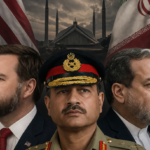
A diplomatic outcast a year ago, demonized extensively as a ‘terrorist state’ by propagandist, eurocentric, and prejudiced media post 9/11; Pakistan has become a trusted regional partner and a mediator between the U.S. and Iran to end the war in the Middle East; a remarkable transformation driven mostly by its powerful military chief, Field Marshal Asim Munir.
The story of how Pakistan arrived here is as much about the depths it fell from as the heights it has reached. Since Osama bin Laden was killed by U.S. Navy SEALs in Pakistan in 2011, ties with the U.S. and the West had plunged. The jailing of former Prime Minister Imran Khan and accusations from Washington that Pakistan was supporting the Taliban behind the scenes during the 20-year Afghan war only made things worse. On the economic front, Pakistan was perilously close to a debt default, until a new deal with the IMF was reached after tough negotiations about 18 months ago.
Two turning points, analysts say, changed everything. In March last year, Pakistan helped capture a suspect linked to the 2021 Kabul airport bombing, earning public praise from Trump and renewed intelligence collaboration. In May, restraint during a 90-hour conflict with India showcased Pakistan’s measured military approach, enhancing its diplomatic credibility.
Why Pakistan? and Why Now?
To understand Pakistan’s unique suitability as a mediator, you have to look beyond the headlines to geography, demography, and quiet historical precedent. Pakistan has the second-largest Shia Muslim population in the world after Iran; roughly 40 million people; giving it a sectarian proximity to Tehran that most Sunni-majority states cannot claim or feign. It signed a mutual defence pact with Saudi Arabia last year, lending it credibility in Riyadh and Washington simultaneously.
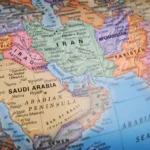
Decades of deep bonds with Iran and a 565-mile border help explain why Pakistan has such knowledge, and Pakistan has long conveyed messages to the United States on Iran’s behalf. As one Islamabad-based researcher put it, Pakistan has represented Iranian interests in Washington for decades, much like the Swiss have done for the United States in Tehran.
This is not, historically, Pakistan’s first act of this kind. Pakistan’s then-President Gen. Yahya Khan facilitated backchannel contacts that led to U.S. President Richard Nixon’s historic 1972 visit to China, paving the way for diplomatic ties between Washington and Beijing in 1979. Decades later, Pakistan played a similar role in the 1988 Geneva Accords that ended the Soviet occupation of Afghanistan, and again in the Doha talks that set the stage for the Taliban’s return to power in 2021.
What made 2026 different was the personal dimension. Munir, who Trump has called his “favourite field marshal,” was the only serving military chief at the World Economic Forum in Davos this year, and the relationship he cultivated there proved decisive when the Iran crisis reached its breaking point. In a White House that runs on personal relationships rather than institutional channels, that personal channel to the Oval Office is not a soft asset; it is the whole game.
The World Responds
The global reaction to the ceasefire announcement was swift and largely warm. UN Secretary-General Antonio Guterres expressed “sincere appreciation for the efforts of Pakistan and other countries involved in facilitating the ceasefire.” EU Commission President Ursula von der Leyen thanked Pakistan for its mediation and called it “much-needed de-escalation.” German Chancellor Friedrich Merz welcomed the breakthrough, also thanking Pakistan.
Malaysian Prime Minister Anwar Ibrahim commended Pakistan’s diplomatic efforts as “tireless and courageous,” saying that “Pakistan’s willingness to speak to all sides, without fear or favour, reflects the highest traditions of Muslim solidarity and international responsibility.”
South Asia expert Michael Kugelman captured the broader consensus: Pakistan had achieved one of its biggest diplomatic wins in years, defying many skeptics who didn’t think it had the capacity to pull off such a complex, high-stakes feat.
What Comes Next; and What Could Go Wrong
The ceasefire is a two-week pause, not a peace treaty. Pakistan’s diplomacy, led by Prime Minister Shehbaz Sharif and Army Chief Field Marshal Asim Munir, laid the groundwork for what’s being termed the “Islamabad Accord”; a two-phase framework for an immediate ceasefire followed by broader negotiations. Both Iran and the United States have been invited to formal talks in Islamabad on April 10.
But caution is warranted. Pakistan’s economy remains in the doldrums, and analysts say it risks being pulled into the war because of the defence pact with Saudi Arabia, which could spark protests from its own Shi’ite community, the second-largest in the world after Iran. Islamabad is also managing a separate, active conflict on its western border with Afghanistan.
As one analyst put it, “The civil-military leadership will need to be very careful of the role and extent of Pakistan’s involvement. Overplaying the mediator card could prove to be more damaging if not managed astutely.”
Pakistan has spent decades learning; sometimes brutally; that being indispensable to powerful states is a double-edged gift. The Islamabad Accord, if it holds, could be the country’s most consequential diplomatic achievement in a generation. If it fractures, Pakistan will have staked enormous credibility on a conflict it does not control. Either way, the world is now watching Islamabad not with anxiety, but with something it has not directed toward Pakistan in years: genuine expectation.