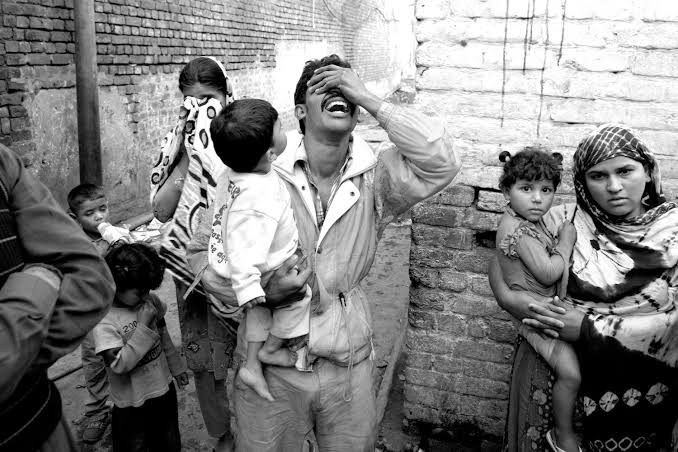
Discrimination against Christians in Pakistan remains a deeply rooted issue shaped by legal, social, and historical structures. The post-1947 Pakistan has created asymmetry in citizenship with regards to the legal, social and economic aspects in which the Christian minorities have a conditional belonging with the state. Dating back to British colonialism, the low-caste Hindus were forcefully converted into Christians. These Christian minorities had no alternative but to settle and survive in a Muslim-majority country, in Pakistan, after 1947. Religious minorities, specifically Christians, have been historically oppressed by the dominant elite of Pakistan, including the state itself. Thus, the term ‘internal colonisation’ is coined, whereby particular religious or ethnic communities are otherised within the same space they have been surviving in. Their existence is weaponised in order to facilitate the majoritarian narrative. This reflects ongoing discrimination against Christians in Pakistan.
Discrimination Against Christians in Pakistan in Law and Society
Legally, the blasphemy laws in Pakistan create a vulnerable space for the Christians. In March 2013, almost one hundred houses were burnt down by the Muslims in Joseph Colony under an unverified allegation of blasphemy on a Christian individual. The mere allegation led towards a ‘collective punishment’ due to which the entire community suffered. There are traces of coloniality of power within the state of Pakistan. The laws enacted by the state are an extension of the colonial hierarchies that existed in the past. The subalterns have never had the voices of their own. Their social statuses are controlled by the dominant elite or the state. Such cases highlight discrimination against Christians in Pakistan.
Economic Marginalization of Christians in Pakistan
The dominant elite within post-1947 Pakistan manages the Christians as ‘internal other’ through workforce and labour. The Christians in Pakistan are mostly hired in the municipal workforce for sanitation and cleaning. Their social mobility is strictly controlled by the elite by not offering secure jobs to them. The low-paid jobs not only com[promise their social mobility but also deprives them of their common citizen rights. Due to their social standing, they are sidelined within the social institutions as well. Even on a political level, the representatives are selected by the political parties in Pakistan. These representatives become the voice of the marginalized individuals, depriving them of their own voices.
Economically and socially, Christians have been confined to marginalized labor sectors. This occupational segregation is not incidental but historically produced, rooted in colonial hierarchies that associated certain communities with “impure” labor. Post-1947 Pakistan inherited and sustained these hierarchies, allowing them to be reframed through religious majoritarianism. Consequently, Christians remain socially visible yet politically voiceless, present within the nation but excluded from its centers of power. Overall, discrimination against Christians in Pakistan continues to shape their lived realities.
The state of Pakistan runs on majoritarian Islamic symbolism, even in the education sector. The historical narratives are selectively sidelined in academics in order to safeguard the dominant elite. This also includes indirect indoctrination of the majoritarian religion and sidelining the minority religion.
Social Exclusion and Everyday Discrimination Against Christians in Pakistan
The constant oppression of the Christian community in Pakistan fits perfectly into Spivak’s framework of subaltern, as these individuals have been historically deprived of their rights and voices.
The formation of Pakistan in 1947 was not only a geopolitical rupture but also an ideological project centered on the construction of a Muslim national identity. While the demand for Pakistan was articulated in terms of safeguarding Muslim political rights in British India, the post-Partition state increasingly defined citizenship through religious belonging and context. This shift laid the grounds for asymmetrical citizenship, where religious minorities, particularly Christians, were positioned as conditional members of the nation rather than equal stakeholders. The legacy of Partition produced an internal hierarchy in which the Muslim majority was normalized as the national subject, while minorities were rendered insignificant.
Reconfiguring Citizenship and Power: Beyond Structural Marginalization in Postcolonial Pakistan
Ultimately, the condition of Christians in Pakistan reveals a deeper paradox within the postcolonial state: the persistence of exclusion not despite independence, but through the very frameworks that were meant to secure sovereignty and identity. What emerges is not simply marginalization, but a carefully sustained order in which insecurity becomes a mode of governance. Legal ambiguity, economic confinement, and cultural misrepresentation together produce a climate where vulnerability is normalized and even instrumentalized. This suggests that the issue extends beyond minority rights into the broader question of how power is maintained and legitimized. If citizenship continues to be mediated through religious belonging, then exclusion will remain structurally necessary to the national narrative. A genuine shift, therefore, lies not only in reforming institutions but in unsettling the ideological foundations that render inequality both rational and enduring.