Why Rising Oil Prices and a Strong Dollar Hit Asia Hardest
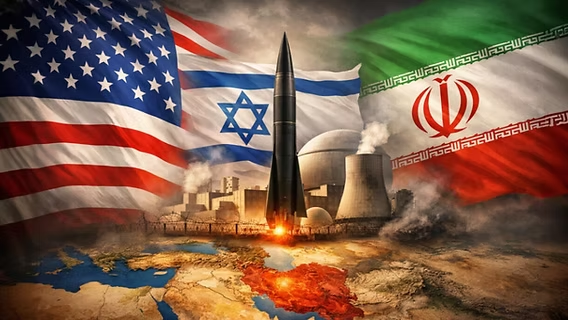
There is a version of the current US/Israel-Iran war in which Washington wins on every metric that matters, i.e; Iran’s nuclear programme dismantled, its proxy architecture degraded, and the Gulf stabilised for American strategic purposes. Such a version presupposes that the economic shockwaves of the war remain within bounds, which they do not. They are actually facilitating the long term financial ambitions of China than ten years of silent yuan internationalisation has been able to achieve; and the mechanism is as elegant as it is unintentional. This also means that the combination of a strong dollar and rising oil prices is placing growing pressure on Asian economies.
The Strait of Hormuz carries a fifth of the world’s traded oil. Iran’s effective blockade of it (tanker traffic falling from over 150 daily transits to a trickle within days of the February 28 strikes) has sent energy prices to levels analysts are comparing to the 1970s shocks, surging the oil prices to $200 per barrel.
The Double Shock: Oil Prices and a Strong Dollar
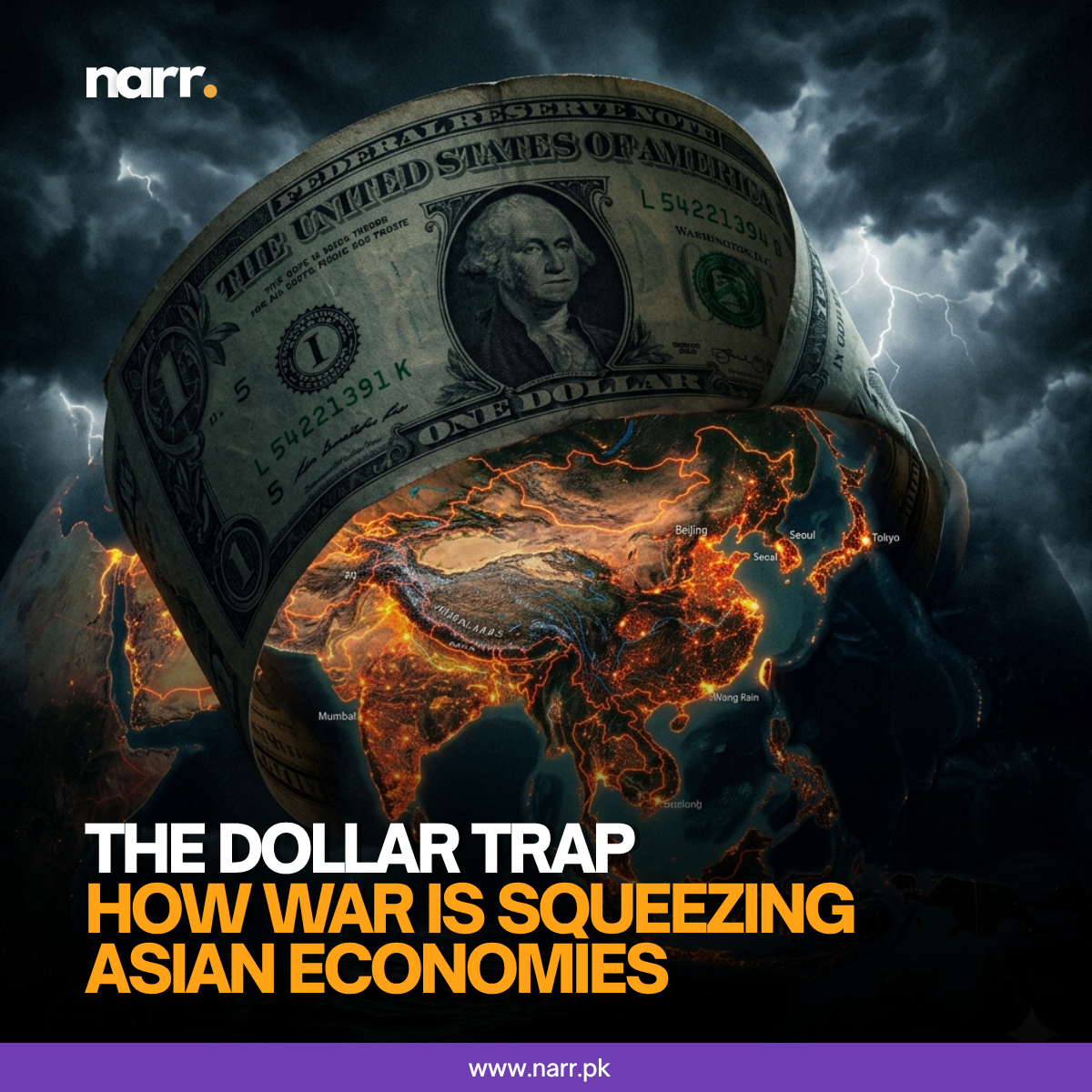
This creates a trap of two jaws for the Asian economies. A trap driven by rising oil prices and a stronger dollar. The oil and energy supply disruption is only half the problem, the second half is structural, whereby it is built into the architecture of the global financial system itself.
The first thing a major geopolitical shock does to financial markets is drive investors toward US assets, because investors prioritise liquidity and safety, both of which are concentrated in dollar-denominated markets. It happened after 9/11, after the 2008 financial crisis, after Russia’s invasion of Ukraine, and it is happening now as well.
Why Investors Flock to the Dollar in Crisis
As the strong dollar pulls capital toward U.S. markets, capital exits riskier markets, demand for dollars rises, and the dollar appreciates. In normal circumstances, a strong dollar is a sign of American financial credibility. In the middle of an oil supply crisis, it is a mechanism of punishment, because an overwhelming majority of international energy trade is denominated in dollars, oil-importing economies are now being hit from both directions simultaneously. This does not weaken the dollar in the short term, infact, it reinforces it, but it also exposes a structural vulnerability. Oil becomes more expensive in dollar terms, and the dollar becomes more expensive in local terms simultaneously, compressing Asian economies already hit by rising oil prices. For economies repeatedly subjected to this double shock, the incentive is not to rely more on the dollar system, it is to build exposure away from it.
How Asian Economies Are Being Squeezed
India’s stock market has lost nearly 13% of its value since the war started. The rupee has hit record lows, meaning Indian and Pakistani households are paying close to double for the same unit of energy, the commodity price and the currency weakness multiplying against each other rather than offsetting. South Korea’s won has matched its weakest level since the 2008 financial crisis; Seoul has deployed a stabilisation package worth tens of billions of dollars in response. The Philippines has declared a national energy emergency. Sri Lanka has shortened its working week to conserve fuel. Thailand’s export industries, which normally benefit from a weaker baht, are finding that advantage cancelled out by collapsed global travel demand and surging diesel costs.
What makes this structurally distinct and worse than the 2022 Russia-Ukraine energy shock is that the relief mechanisms that worked then do not apply here. In 2022, global energy markets rerouted, substituted, and redirected. A physical chokepoint carrying a fifth of the world’s traded oil has no rerouting equivalent. As Moody’s Analytics has warned, even a ceasefire does not flip a switch, infrastructure takes time to restart, risk premiums on recently closed shipping lanes persist after deals are signed, and fuel prices, as the industry adage goes, rise like a rocket and fall like a feather.
A Shift Away From the Dollar System
This is where the strategic picture sharpens. While the rest of Asia burns through foreign reserves and watches currencies depreciate, China is navigating a different reality. Iran established a vetted safe corridor between Larak and Qeshm islands on March 13, and the first confirmed Chinese-owned cargo vessel transited it on March 23, broadcasting “China Owner” through its AIS system, according to Caixin. Since the war began, Iran has shipped at least 11.7 million barrels of crude oil to China through the strait, all of it, according to TankerTrackers.com, destined exclusively for Chinese buyers. Meanwhile, before the strikes, Beijing had accelerated its oil stockpile build-up, with crude imports running 15.8% above the previous year, according to Chinese customs data. China is not merely surviving the closure. It helped design the conditions that preceded it, and is now among the few economies not paying the full price of it.
The contrast carries a logic that extends beyond the current conflict. The countries absorbing the most financial damage from the war in the status quo, i.e; India, South Korea, Japan, the Philippines, are the same countries Washington needs as coalition partners in any future confrontation with China. Harvard economist Kenneth Rogoff framed the endpoint of this precisely by stating that a dollar that repeatedly punishes the economies that depend on it will eventually face questions about whether it remains a trusted partner at all. That question is not being asked in Washington. It is being asked in the capitals that cannot afford the answer, and are beginning, at cost, to look for alternatives. If the current combination of a strong dollar and rising oil prices continues, Asian economies may accelerate efforts to reduce dependence on the dollar.