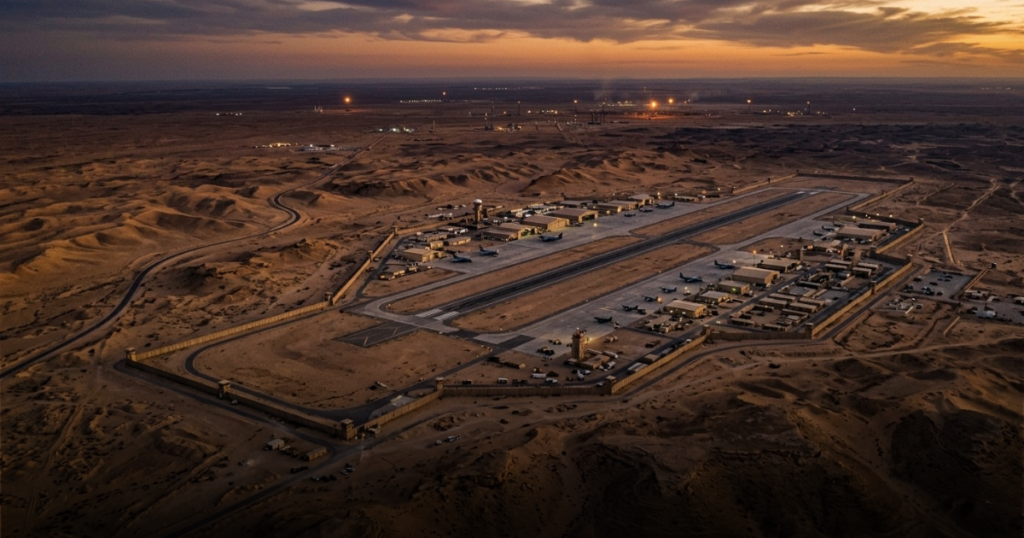
The Origins of U.S. Military Bases in the Middle East
In 1945, Washington decided to build a military base in Saudi Arabia, part of what would become a broader network of U.S. military bases in the Middle East. Its own officials admitted it served no military purpose. What, then, was it purchasing, and for whom? And how does a presence justified as temporary become, by institutional gravity, effectively permanent, producing the very instability it was deployed to prevent?
These are not rhetorical questions, and there is an official document that provides answers to them. A declassified document records a 1945 letter from U.S. Secretary of State Joseph Grew to President Harry Truman. In it, Grew advised completing a military airfield at Dhahran in eastern Saudi Arabia. Germany had already capitulated. Grew admitted that there was no more military necessity to the installation. The argument he put forward was that the base was in the national interest. It would enhance the political integrity of a nation whose huge oil deposits were, as he put it, under American control. Grew, then, almost as an afterthought added, that the American civil aviation would also gain by civilian use of the airfield.
Oil, Strategy, and the Dhahran Airfield Decision
The Dhahran airfield was not built out of wartime necessity. It was built because nearby oil fields were already operated by the Arabian American Oil Company, a group that descended from Standard Oil, and Washington believed physical presence was necessary in close proximity to that oil. The base would be shifted, nominally, to a civilian use. Nevertheless, it would not lose military capabilities, as the architecture was authored with deniability.
The Dhahran arrangement became a model. It offered American military guarantees to a ruling elite in exchange for access to land. This deal operated far beyond the line of popular consent. And most importantly, this arrangement was not a by-product, as was the case with the European imperial model.
It also made no colonial masters, no occupation flags, no native civil service that was trained in colonizer language. Instead, it generated a network of access points which were deniable, flexible and, according to the architects, could be renewed indefinitely. It was a form implying restraint. It was another matter of substance.
How Arab Regimes Used U.S. Military Presence for Political Survival
In 1970, an intelligence assessment of American installations in Kenitra, Morocco emerged with unusual candor by the State Department. It noted that king Hassan II had been employing the American military presence not to achieve security but to survive politically. His American option served as a balancing rod, against home opposition, against Algeria, France, and the Soviet Union. His 1963 visit to Washington had enabled him to attract an implied American approval of a controversial system of constitution which he had installed unilaterally.
Ironically, the Americans were being used as much as they were using others. The note had been concerned that Hassan was undermining the arrangement to an excessive degree by using it too aggressively in seeking further aid..
This is what traditional accounts of American power projection tend to leave out. American forces were not simply imposing decisions on host regimes. Instead, the relationship entailed a compromise, whereby, in many cases, those regimes proved more politically shrewd than Washington acknowledged. Gulf states did not regard the American military presence as a way of countering external threats alone but also as a way of countering internal ones; the American guarantee of the stability of dynasties that based their legitimacy on something other than popular consent. The organization was reciprocal. And the instability that it caused was, also, reciprocal.
The Gulf War and the Expansion of U.S. Military Bases in the Middle East
The Gulf War can be best described as a spectacle of American determination. The fact of its opening was the death of the pretense of the over-the-horizon. Until 1991, the United States had had what military planners referred to as low-visibility presence in the Gulf; troops at sea, prepositioning agreements on paper, the fiction of contingency. Since the year 1991, the fiction was given up. In 1991, 1992 and 1994, defense cooperative agreements were signed with Kuwait, Qatar and the UAE respectively. the finer points were kept secret, at the bequest of the Gulf governments, not so as to prevent strategically embarrassing some domestic opposition forces, as one piece of writing put it, but because giving them a political controversy.
Washington was not demanding the secrets. It belonged to Bahrain, Kuwait, Qatar. The governments desired the security without the exposure. The United States accepted, as it was necessary to have the access. They were both saving what they felt was left of their own stand.
When U.S. Military Presence Became a Source of Instability
What this permanence produced was the same dynamic that it was meant to possess. The deployment of American troops on the Arabian land, the home of the two holy mosques, was the foremost political complaint of Osama bin Laden who had volunteered to raise an Arab fighting force to counter the Iraqi invasion to Kuwait in 1990 and had been denied. The bombing of the Khobar Towers in 1996, the embassy bombings in East Africa in 1998, the USS Cole attack in 2000: each of these was, according to the logic of political action of its instigators, not to the American foreign policy in general, but to the visible physical reality of American military presence in the Gulf.
The foundation was now the provocation no less than the protection. And the governments that had welcomed it were left doing an ever more dangerous dance; posturing publicly to distance themselves with American policy, and privately relying on American insurance, how to govern populations which were themselves being fanned into a frenzy by the very presence of their governments. Formal position and operative reality had become almost unworkable. This is not a coincidence of execution. It is an imperative of the original plan, which necessarily had to be that the form should say one thing and the substance another.
Conclusion
In the 1970 Kenitra note, a concern that has not fared very well was the fact that Hassan was leveraging the American presence to a point that it could prove more costly to the political than the strategic. It was an issue of a deal that both were playing. This was not, and could not have been, a concern about the populations on whose soil the bargain was being made.
It is that omission which this history has never cleared up. A combination of what the documents disclose is not merely a report on strategic decisions. They present a system, one, in which access was bought through guarantees. Those guarantees required a continued presence. That presence then produced instability, which in turn justified further presence. A system in which the transaction itself was always made far above the line of consent, and the deniability itself was not an ex post facto decision, but was a design choice, a decision made at the outset.
The contingent base that was justified is by institutional inertia, made permanent. And the architecture, however reconfigured, still has not yet discovered a means of answering the question to which it was designed to be insincere.