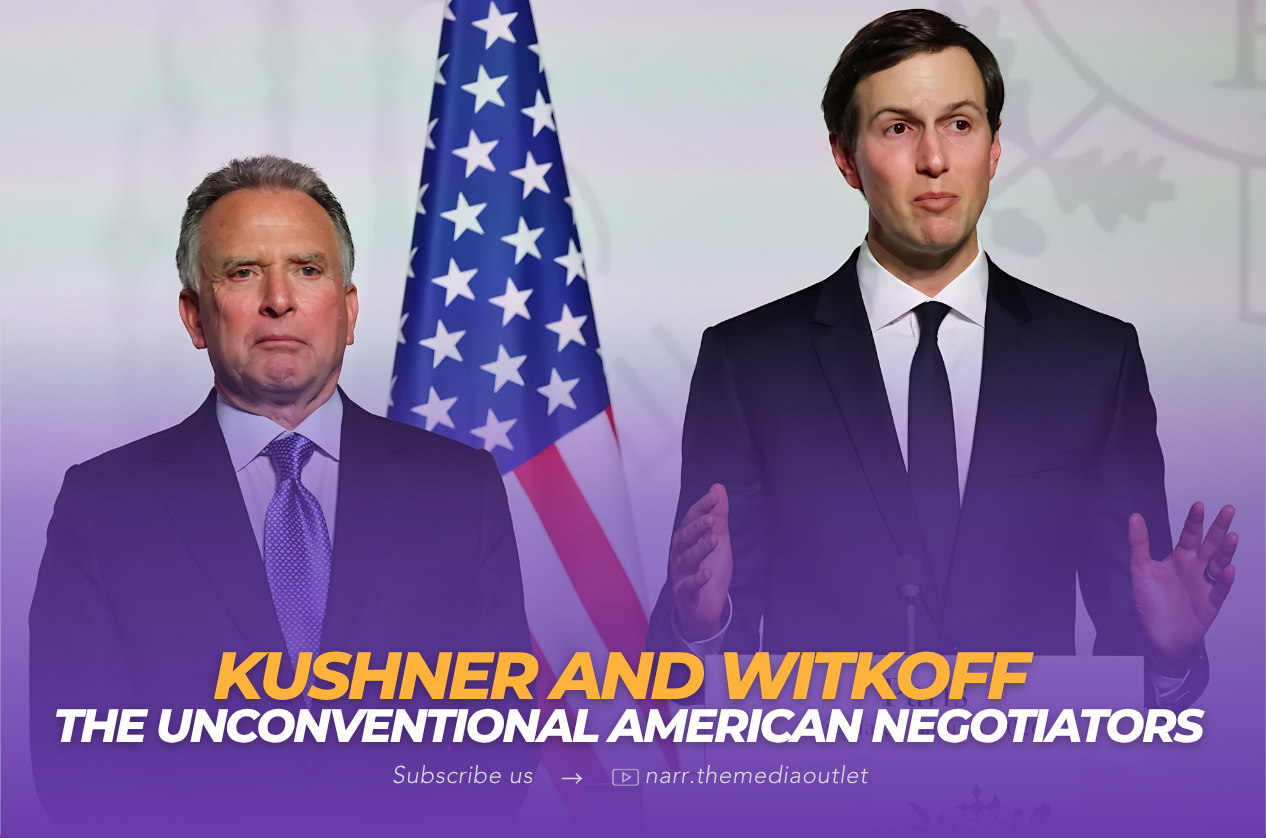
Jared Kushner and Steve Witkoff do not fit the conventional profile of American negotiators.
One is a political insider whose authority derives as much from proximity to power (being President Trump’s son-in-law) as from formal expertise. The other, a real estate developer turned envoy, approaches diplomacy with the cadence of a deal rather than a doctrine. Kushner’s central foreign policy credential remains the Abraham Accords (2020). He led negotiations that normalized ties between Israel, the UAE, and Bahrain, later extending to Sudan and Morocco. His close ties with Gulf leadership allowed him to bypass institutional scrutiny. At the same time, they narrowed the process to a small, opaque circle. He largely worked outside traditional diplomatic channels and structured agreements around bilateral normalization. In doing so, he sidelined the Palestinian issue while aligning Gulf states more closely against Iran. Critics argue that this framework traded long-term stability for short-term realignment. He also designed the administration’s “Peace to Prosperity” plan. The proposal drew widespread criticism for its one-sided framing and lack of Palestinian participation. It reinforced a broader pattern of dealmaking that prioritised alignment over consensus. Witkoff’s diplomatic record is narrower and more recent. Before taking on Iran, he played backchannel roles in hostage-release efforts linked to the Gaza war. Soon after, he was elevated to handle multiple negotiation tracks at once, including Iran. This expansion came despite the absence of a technical nuclear advisory team, a gap that experts say contributed to misreadings during the talks.
US Diplomacy as Deal-Making, Not Strategy
Inside the Trump administration, this approach appears less incidental and more deliberate. As Politico reported, “the unprecedented dynamic of two men leading negotiations with Iran, Israel and Hamas, and Ukraine and Russia, sometimes all in one afternoon, underscores how the Trump administration believes peace deals should be forged.” The same report states that critics accuse President Trump of placing overwhelming trust in underwhelming people and describes
diplomacy as being treated “like a real-estate venture, requiring a business mindset
and a small team tasked with securing a big development deal”.
From Negotiation to Escalation
In the final weeks before the war, Witkoff’s own language suggested that the negotiating track had already been subordinated to escalation. “There’s almost no stopping them,” he said of Iran’s nuclear programme, conveying misleading evidence and statements pushing the US toward the conflict. “They thought they could strong-arm us… it was going to be impossible, probably by the second meeting.” Days later, he doubled down:
“They told me and Jared, ‘We’re not going to give you diplomatically what you couldn’t take militarily.’”
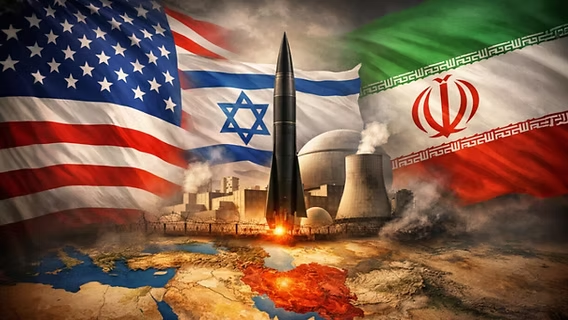
Such statements did more than signal pessimism; they reframed negotiations as futile, ultimately prompting the US attacks on Iran and, ironically, signalling quite the opposite intent of diplomatic negotiations. According to multiple reports, Witkoff and Kushner informed the White house that Iran was using talks to buy time for their nuclear project development, a conclusion that factored into ‘Trump’s decision to greenlight the operation’, further reaffirmed by Trump’s claim “A lot of people are going to be joining the Abraham Accords, now that Iran is decimated”, suggesting that military escalation could feed back into diplomatic gains.
A Record of Limited Outcomes
What’s absurd is Trump’s continued confidence in his negotiating team when their record of conflict resolution remains quite questionable. While Kushner and Witkoff have been credited with securing the release of Israeli hostages, the ceasefire they helped broker remains flimsy, with Hamas still operational in Gaza. Parallel efforts elsewhere have also yielded limited results, i.e, negotiations over Ukraine have yet to produce a durable ceasefire, and attempts to secure Iranian concessions on uranium enrichment ultimately collapsed.
Access Over Expertise
Kushner’s trajectory, as outlined in The New Yorker, moves from leading Kushner Companies to serving as a senior White House adviser on Middle East policy, despite having no prior diplomatic or technical background. His 2016 meeting with Sergey Gorkov, head of Russia’s state-owned Vnesheconombank, reportedly took place without basic preparation. It reflected a broader style in which access substituted for expertise.
Witkoff, by contrast, entered as Trump’s Middle East envoy from a similar real estate background but adopted a more openly combative posture. He often cast negotiations as futile even before they had run their course.
Did Diplomacy Actually Fail?
Yet accounts from mediators and officials present at the talks complicate that narrative. Omani, UK, and other Western intermediaries suggest that Iran had, in fact, made concessions to a “surprising” degree, even exceeding earlier nuclear frameworks. This raises a deeper question: did the breakdown result from Iranian intransigence, or from American misreading? British national security adviser Jonathan Powell similarly described Tehran’s offer as “significant enough to prevent a rush to war,” indicating that diplomacy had not been fully exhausted.
Trust, Not Terms: Why Talks Collapsed
For Tehran, however, the issue has shifted from terms to trust. Iranian officials have since refused to engage with Kushner and Witkoff altogether, describing prior negotiations as a facade that coincided with preparations for military action.
“With the previous negotiating team, there’s no chance,” one diplomatic source said, characterizing talks as a “round of deception” as Iranian officials considered Witkoff and Kushner responsible for the U.S. strikes, claiming they had “stabbed them in the back” after sitting down for nuclear talks while Washington was already planning the opening strike of Operation Roaring Lion, known in the United States as Operation Epic Fury.
This rejection has shifted focus toward Vice President JD Vance as a potential US negotiator. Iranian officials see him as more credible, not because of alignment, but because he is less closely tied to the failed negotiations and the escalation that followed. One source noted, “If the negotiations are going to have any outcome, JD Vance should join… With Witkoff and Kushner, nothing will come out of it.”
That preference reflects his position within the administration. Vance is widely seen as more sceptical of deeper U.S. involvement in the Middle East. At the same time, he has publicly defended the Iran operation, arguing that while “nobody likes war,” the objective remains to prevent a nuclear Iran and that officials must ultimately implement presidential decisions.
A Crisis of Trust in US–Iran Relations
The current deadlock, therefore, is not only about stalled negotiations but about a collapse of trust. For Tehran, Jared Kushner and Steve Witkoff are no longer neutral diplomats. They are now seen as part of a process that led directly to war.