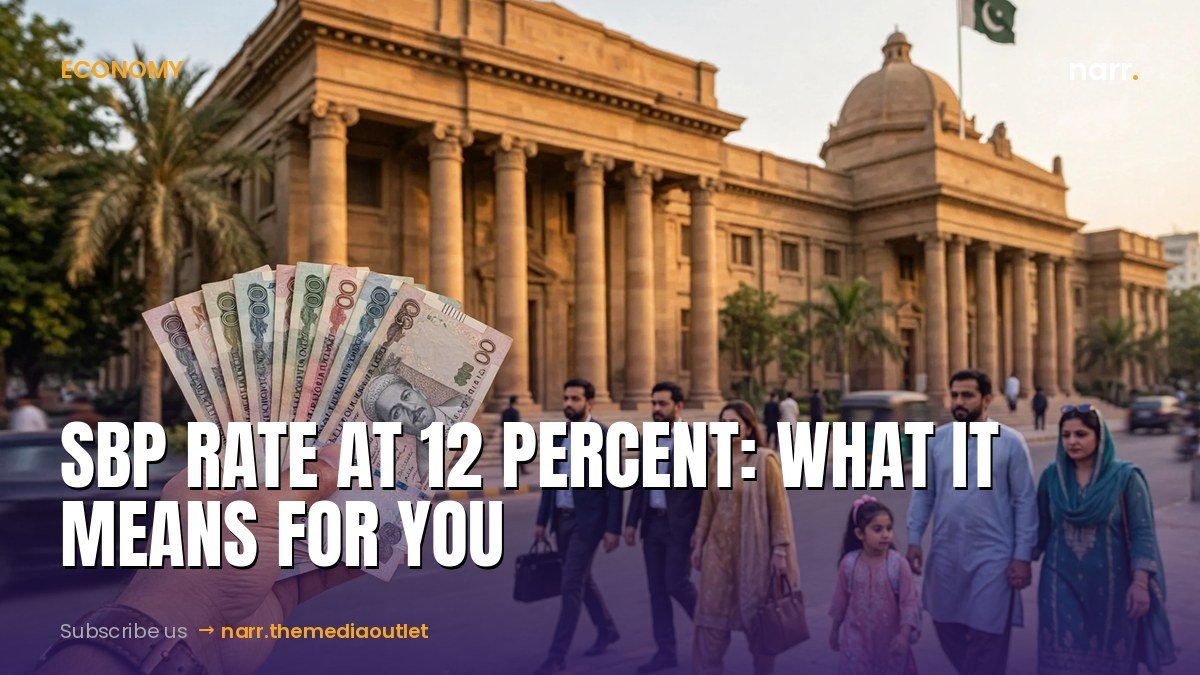
The State Bank of Pakistan has raised its policy rate to 12 percent. This explainer covers what the decision was, why the central bank made it, and what it means in practice for a loan, for savings and for a small business. It does not quote any single bank's loan or deposit rate, because banks set their own rates: the policy rate moves the anchor, not every account on the same day.
The decision in numbers
On 26 October 2026, the State Bank's Monetary Policy Committee raised the policy rate by 50 basis points, from 11.5 percent to 12 percent, with effect from 27 October 2026. A basis point is one hundredth of a percentage point, so 50 basis points is half a percentage point. Nine of the committee's ten members voted for the increase, and one member favoured a larger rise. The policy rate is the rate at which the central bank lends to commercial banks, and it is the anchor for interest rates across the economy, from business loans to the benchmark used to price many bank borrowings. The move ends a run of meetings at which the rate was left unchanged at 11.5 percent.

Why the rate went up
The central bank said the inflation outlook had deteriorated since its last assessment. Headline inflation was 10.3 percent year on year in September 2026, above the committee's expectations, and core inflation, which leaves out food and energy, was around 8.4 percent. The drivers named were the intensifying Middle East conflict, persistently high global energy prices with crude oil above 100 dollars per barrel, and domestic wheat supply frictions, meaning wheat supply problems that push food prices up. The committee said the increase was needed to anchor inflation expectations, meaning to stop people and businesses expecting prices to keep rising, and to prevent higher food and energy costs feeding into broader prices. Its medium term inflation target range is 5 to 7 percent. It also kept its growth outlook for fiscal year 2027 at 3.5 to 4.5 percent, and raised its remittance forecast from 44 billion dollars to 45 billion dollars.
What it means for a loan
If your loan rate moves with the market, expect it to move up at the next reset, and expect a new loan to cost more than it did before 27 October. If your loan rate is fixed, it does not change until renewal. As an illustration only, not a bank quote: half a percentage point on a loan balance of Rs 1,000,000 adds Rs 5,000 of interest per year before compounding and fees. On a larger balance the same half point adds proportionally more, which is why the same decision feels small on a small personal loan and large on a business working capital loan. Before signing a new loan, ask the bank for the exact rate, whether it is fixed or variable, when it resets, and what the total monthly instalment will be: none of those figures can be read off the 12 percent policy rate alone.
What it means for savings
Deposit profit tends to rise when the policy rate rises, because banks earn more on the funds they place, but each bank sets its own savings profit rate and its own timing. Do not assume your account now pays 12 percent: check your bank's announced profit rate for your account type. The gap between the policy rate and your account rate is normal, because the policy rate is a wholesale anchor, not a retail deposit rate. If you hold cash savings, the decision also matters in a second way: with headline inflation at 10.3 percent and the policy rate at 12 percent, the central bank is trying to keep the return on rupees ahead of rising prices, so that saving in rupees still beats holding cash that loses value to inflation.
What it means for a small business
For a shop, workshop or small manufacturer, the immediate effect is dearer working capital: stock bought on credit, an overdraft, or a short term business loan will cost more to carry. That can push a business to hold less stock, delay an expansion, or pass part of the higher cost into prices, which is exactly the second round effect the central bank is trying to limit. The offset is on the demand side: if the rate rise helps bring inflation down, input costs, especially fuel and wheat-linked costs, stop rising as fast. A business planning a large purchase on credit should compare the cost of borrowing now against waiting, and should not assume the rate will fall back at the next meeting: the central bank has tied its next move to inflation prints, oil prices, wheat prices and possible energy tariff adjustments.
What to watch next
Watch the next inflation print against the 10.3 percent September figure, the next oil price move, and the next Monetary Policy Committee meeting. If inflation falls back toward the 5 to 7 percent target range, the pressure for further rises eases. If oil and wheat prices rise again, the central bank has signalled it will act to keep expectations anchored. For households, the practical check is your own bank's next statement: the loan instalment or the savings profit rate on it, not the headline 12 percent.
Related: Petrol Price in Pakistan Today
Related: Pakistan BPS Salary Chart 2026: Complete Pay Scale 1 to 22 with Allowances
Sources: State Bank of Pakistan Monetary Policy Statement, 26 October 2026, as reported by Dawn, PK Revenue and The Scoop, 26 to 27 October 2026; State Bank Governor press remarks as reported by Dawn and PK Revenue; SBP policy rate corridor reporting, October 2026.

Sindh Police Ranks and Salary 2026: Complete List with BPS Grades
Sindh Police ranks and salary 2026: Constable BPS-07 to IG BPS-22, starting basic pay from the BPS-2026 scale, and the…

Petrol Price in Pakistan Today: Rs 376.06 per Litre from 28 October 2026
Petrol Rs 376.06 per litre and diesel Rs 398.07 per litre from 28 October 2026, after a Rs 3.19 petrol…

How to Join Pakistan Air Force: Eligibility, Physical Standards and Selection Process
How to join PAF as an officer: GD(P) and Aeronautical Engineering eligibility from the July 2026 induction pattern, selection steps,…
