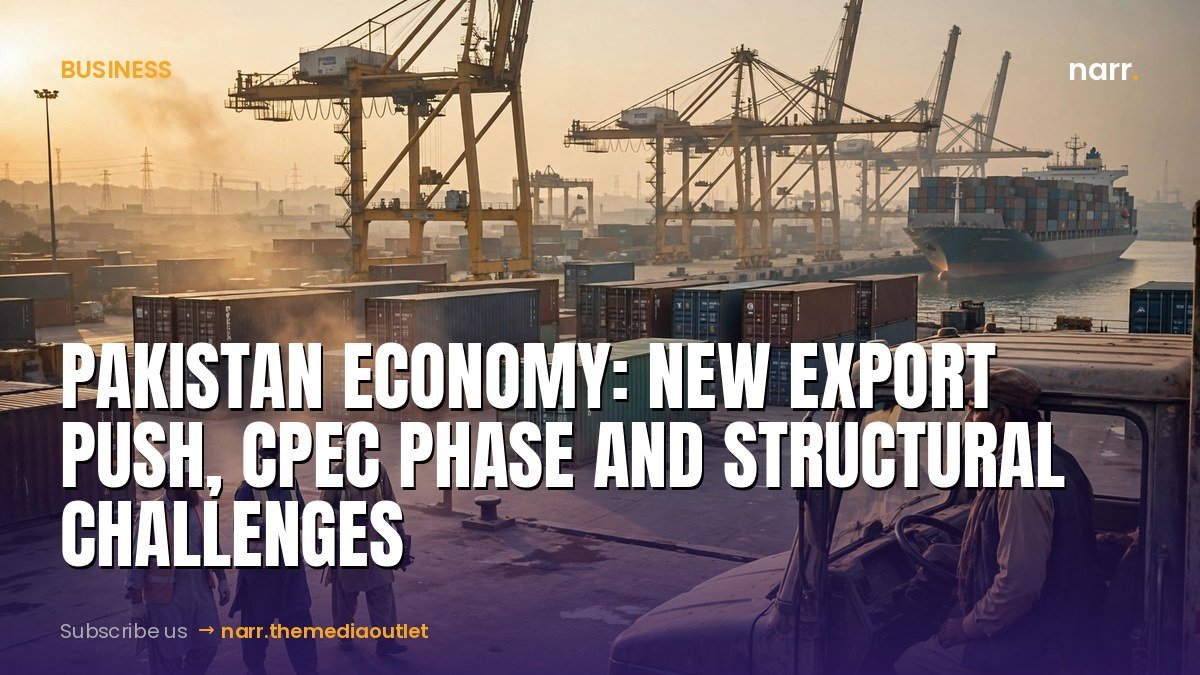
- Prime Minister Shehbaz Sharif urged the private sector to lead export‑driven growth on October 1.
- Pakistan and China have entered a new CPEC phase focusing on energy and industrial projects.
- Terrorism and the Afghanistan conflict are identified as structural constraints on the economy.
- Analysts warn that copying China’s growth model may not suit Pakistan’s institutional context.
Pakistan’s economy is at a crossroads. On October 1, Prime Minister Shehbaz Sharif urged the private sector to spearhead an export‑driven recovery, a call that comes as the country negotiates a fresh phase of the China‑Pakistan Economic Corridor (CPEC) and grapples with security and regional challenges that threaten to stall progress.
Private sector as the engine of growth
In a televised address reported by Tribune, the prime minister emphasized that sustainable growth cannot rely solely on public spending. He asked manufacturers, agribusinesses and technology firms to expand overseas markets, improve product standards and tap into new trade agreements. The message aligns with a broader government strategy to reduce the current account deficit and create jobs, but concrete policy incentives were not detailed in the source.

CPEC moves into a new phase
According to Business Recorder, Pakistan and China have agreed to launch a new phase of CPEC that will focus on energy projects, industrial parks and logistics hubs. The announcement signals a shift from earlier infrastructure‑heavy investments toward value‑added sectors that could complement the private‑sector export drive. No specific timelines or financing terms were disclosed, leaving analysts to watch for further clarification.
China model fallacies and domestic realities
Dawn published a critique titled “China model fallacies,” warning that Pakistan cannot simply copy China’s state‑led growth formula. The piece argues that Pakistan’s institutional capacity, governance standards and market dynamics differ sharply, and that over‑reliance on large‑scale projects may crowd out small‑ and medium‑sized enterprises that are vital for export growth.
Security constraints on the economy
A joint report by UA.NEWS and Dawn on September 29 highlighted terrorism as a structural constraint on Pakistan’s economy. Persistent attacks raise costs for businesses, deter foreign investors and limit the mobility of labor. The report does not provide new casualty figures but underscores that security remains a top priority for economic planners.
Afghanistan conflict and its spillover effects
The Council on Foreign Relations tracker notes that ongoing conflict in Afghanistan continues to affect Pakistan through cross‑border trade disruptions, refugee flows and security pressures. While the article does not quantify the economic impact, it confirms that regional instability adds another layer of uncertainty to Pakistan’s growth outlook.
Infrastructure gaps: the dam debate
Chitral News explored a hypothetical scenario: what if Pakistan had prioritized dam construction from day one? The analysis suggests that earlier investment in water storage could have mitigated current energy shortages and supported agricultural exports. The piece is speculative but reinforces the argument that long‑term infrastructure planning is essential for economic resilience.
Taken together, these reports paint a picture of an economy seeking to diversify, modernize and secure its future amid persistent security and geopolitical challenges. The private sector’s response to the prime minister’s call, the details of the new CPEC phase, and the implementation of security reforms will determine whether Pakistan can translate ambition into measurable growth.
Sources: Council on Foreign Relations, UA.NEWS, Tribune, Dawn, Business Recorder, Chitral News.
Frequently Asked Questions
What is the new phase of CPEC about?
Why does the government want the private sector to drive exports?
How do security issues affect Pakistan’s economy?
Gold rate today in Pakistan: 24K gold climbs to Rs 442,036 per tola on October 12
The All Pakistan Sarafa Gems and Jewellers Association fixed 24-karat gold at Rs 442,036 per tola on Monday, up Rs…

Pakistan Stock Exchange activity spikes as investors track top movers
Investify and TradingView posted the latest PSX prices, gainers, losers and active stocks, highlighting why the market is a focal…

Sadaqat's 96 Powers Pakistan to 82-Run Win Over Sri Lanka, Series Sealed 2-0
Maaz Sadaqat's 96 off 51 and captain Sahibzada Farhan's 73 powered Pakistan to 215 for 3 before Mohammad Imran's 3…
