
Young job seekers around the world are facing a difficult time, especially recent graduates or those with limited experience, as they find themselves facing a highly competitive job market.
In 2024, unemployment looked very different depending on the country. It was as low as 1.4% in the Czech Republic and Poland,the lowest in the world,while Turkey faced a much higher rate of 9.2%. Across the European Union, the average stood at 3.8%, according to Euronews.

In the United States, the labor market is experiencing a marked stagnation for new entrants. Data from the Federal Reserve Bank of New York shows that in June, about 4.8% of recent college graduates were unemployed,slightly higher than the 4% unemployment rate for the overall workforce.
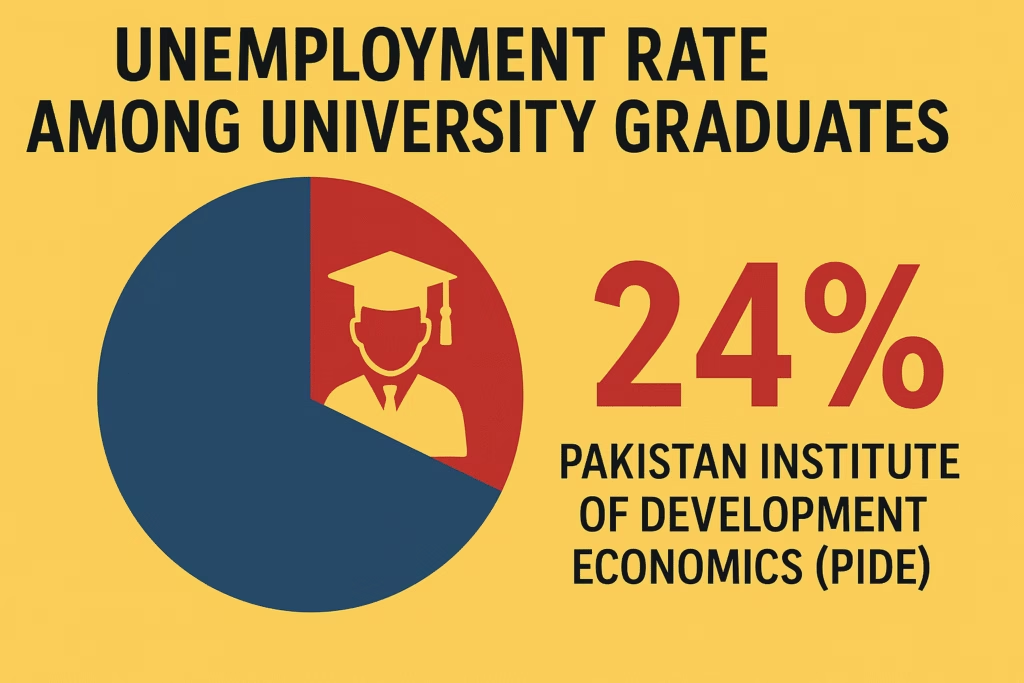
In Pakistan, young university graduates in many cities face high unemployment rates, reflecting clear challenges in aligning education with labor market requirements. The unemployment rate among university graduates stands at 24%, according to the Pakistan Institute of Development Economics (PIDE).
Specialization without unemployment
However, there is one major whose graduates are not unemployed, and earn salaries in the hundreds of thousands of dollars annually, with some earning at least a million dollars a year.
This specialization is artificial intelligence , machine learning, and related subspecialties. There are young people in their early twenties with experience in this field, and several of them earn $1 million annually, according to the Wall Street Journal.
According to a new report from AI recruiting firm BurtchWorks, which analyzed salaries and compensation for thousands of AI and data science professionals.
The report found that those with expertise in artificial intelligence are promoted to management positions nearly twice as fast as their counterparts in other technology fields. They advance through the ranks based on their skills and influence, not their years of work experience.
Investment in the future
Artificial intelligence has become an integral part of the modern workplace and is seen as a transformative force comparable to the steam engine in the 19th-century Industrial Revolution .
This is thanks to advanced large language models (LLMs) developed by major global technology companies such as OpenAI, Meta, Google, and others.
McKinsey research indicates that AI holds enormous long-term potential, estimated at $4.4 trillion in additional productivity growth opportunities, thanks to the increasing corporate use of this technology.
Studies confirm that the future prospects for artificial intelligence are very broad, with 92% of companies worldwide planning to increase their investments in this field over the next three years, reflecting the beginning of the technology's full integration into workflows and its ability to achieve tangible business results.

Artificial Intelligence Citizen
Therefore, it's no surprise that demand for AI graduates is increasing around the world. AI is the backbone of the Fifth Industrial Revolution, and its employees command astronomical salaries.
While the term "digital native" has traditionally been associated with a generation that has been accustomed to interacting with digital technology since its early years, the current era calls for a new term: "AI native," according to Entrepreneur magazine.
This description applies to recent graduates who earn salaries reaching hundreds of thousands of dollars upon entering the job market, thanks to their ability to employ and invest in AI tools efficiently.
imaginary salaries
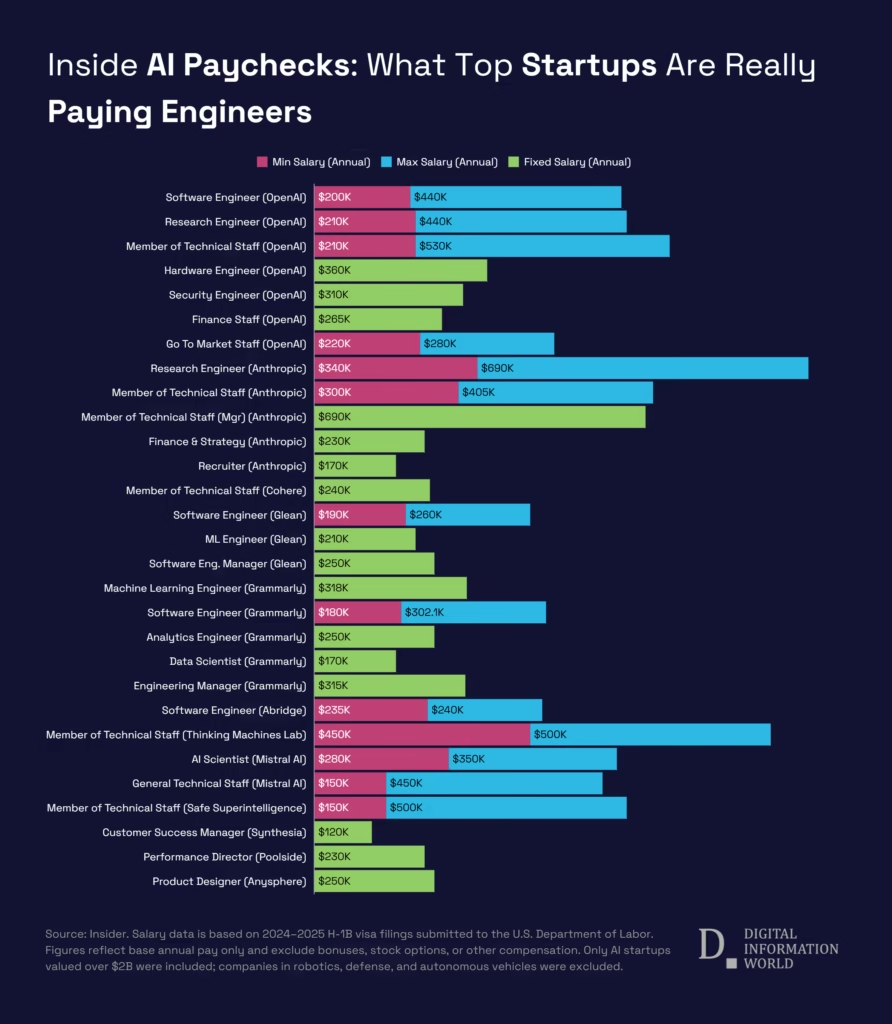
According to Databricks' job postings, a generative AI researcher with less than two years of experience can earn a base salary of $190,000 to $260,000 per year, including incentives and stock awards, The Wall Street Journal reported.
Databricks, a data analytics software company whose value has skyrocketed during the AI boom, plans to double the number of people it hires immediately after graduation this year, largely due to their knowledge of AI.
The company completed a $100 billion funding round last August, a 61% increase from its last funding round in December, according to another report by the Wall Street Journal.
"We definitely have entry-level people, but they're highly influential and highly paid," CEO Ali Qudsi said, according to the newspaper. "At the age of 25, you can make $1 million."
Even in the job market for AI experts, disparities remain stark. Gore Leskovic, a professor of computer science at Stanford University and co-founder of the startup Kumo.AI, notes that PhD students in their early twenties often produce influential research but leave their programs early to join companies offering lucrative salaries. "The number of zeros on salaries is too high," he says.
"There is another group that is adept at using AI," Leskovic adds. "They learn fast, think fast, and leverage technology to enhance their productivity."
"At the age of 25, you can make $1 million."
"Ali Qudsi, CEO of Databricks"
Although they do not hold advanced degrees, the gap between them and traditional programmers is widening in their favor. "They represent the new generation of software engineers," according to the same source.
The Future of Hiring Trends
Levels.fyi reports that many AI and machine learning engineer positions, even for those with as little as one year of experience, offer salaries of up to $200,000 per year at companies like Roblox. The site also identified 42 AI job offers worth over $1 million, nine of which had less than 10 years of experience, despite some holding doctorates.
At Scale AI, which recently underwent a reverse acquisition by Meta, employees under the age of 25 make up about 15% of the workforce, and company data indicates that recent graduates can expect base salaries of around $200,000 per year, according to the Wall Street Journal and MSN.
Opportunity and challenge
These figures clearly demonstrate that young people, even those in their early twenties, are capable of making a huge impact in the field of AI, and earning exceptional salaries before gaining extensive practical experience.
This presents Pakistani youth with both a challenge and an opportunity. With unemployment rates among graduates rising, it has become imperative to think intelligently when choosing a university major and focus on future fields that transcend borders and geography.
This phenomenon confirms that practical skills and proficiency in using technology can sometimes become more important than traditional academic credentials, signaling a radical shift in the job market and the future of software and digital engineering.
Curious about which skills can future-proof your career? Don’t miss our piece: Which Skills Matter? LinkedIn Chief Explains

Peshawar School Roof Collapse Kills At Least 35, Mostly Students; Rescue Operation Ends
At least 35 people, including 34 students and a female teacher, were killed on Thursday when the roof of a…

Kusal Mendis's Unbeaten 87 Ends Pakistan's Whitewash Bid as Sri Lanka Win 3rd T20I by 8 Wickets
Kusal Mendis smashed an unbeaten 87 off 48 balls as Sri Lanka chased 169 to beat Pakistan by 8 wickets…

Pakistan Seal Sri Lanka T20I Series 2-1 as Farhan Wins First Series as Captain
Pakistan beat Sri Lanka 2-1 in the T20I series at Rawalpindi, sealing new captain Sahibzada Farhan's first series win despite…
